By the late 18th century, bitch had become so improper that Captain Francis Grose, compiler of The Classical Dictionary of the Vulgar Tongue (1785), declared it ‘the most offensive appellation that can be given to an English woman – even more provoking than that of whore.’ For Samuel Johnson, the word was so distasteful he could only allude to it in an anecdote to his friend: ‘I did not respect my own mother, though I loved her; and one day, when in anger she called me a puppy, I asked her if she knew what they called a puppy’s mother.’ A common saying at the time ran: ‘I may be a whore, but can’t be a bitch,’ roughly equivalent to the modern retort: ‘I may be drunk, but you’re ugly.’ It was arguably better to be a prostitute, who was, at least, paid for her labour, than to be a bitch.
Over time, bitch has been used to label women as promiscuous, unpleasant, disagreeable, despicable, treacherous, nagging, spiteful, mean, malicious, manipulative, annoying and much else besides. This sense still bears traces of the word’s literal origins, invoking the image of a feral mother dog snarling, growling, barking and biting to protect her young and drive others away. But ‘bad’ words can be retrained.
During the first wave of feminism in the 19th and early 20th centuries, bitch became a familiar backlash aimed at women who sought equal rights and broader opportunities in society. In the second wave, however, feminists pushed back, deliberately reclaiming the insult as an act of defiance and empowerment, much as ‘queer’ and ‘gay’ were later reappropriated by the LGBTQ+ community. In 1968, Jo Freeman wrote the feminist tract ‘The Bitch Manifesto’, published under the pseudonym Joreen, in which she argued that women branded ‘bitches’ are often those who are outspoken, confident, assertive and strong-minded. Freeman exposed a familiar double standard: traits celebrated in men are condemned when they appear in women. What counts as ‘dominant’ behaviour in men is recast as ‘difficult’ in women. Men are assertive; assertive women are ‘aggressive’. Men are competitive; competitive women are ‘combative’. He’s a boss, but she’s ‘bossy’.
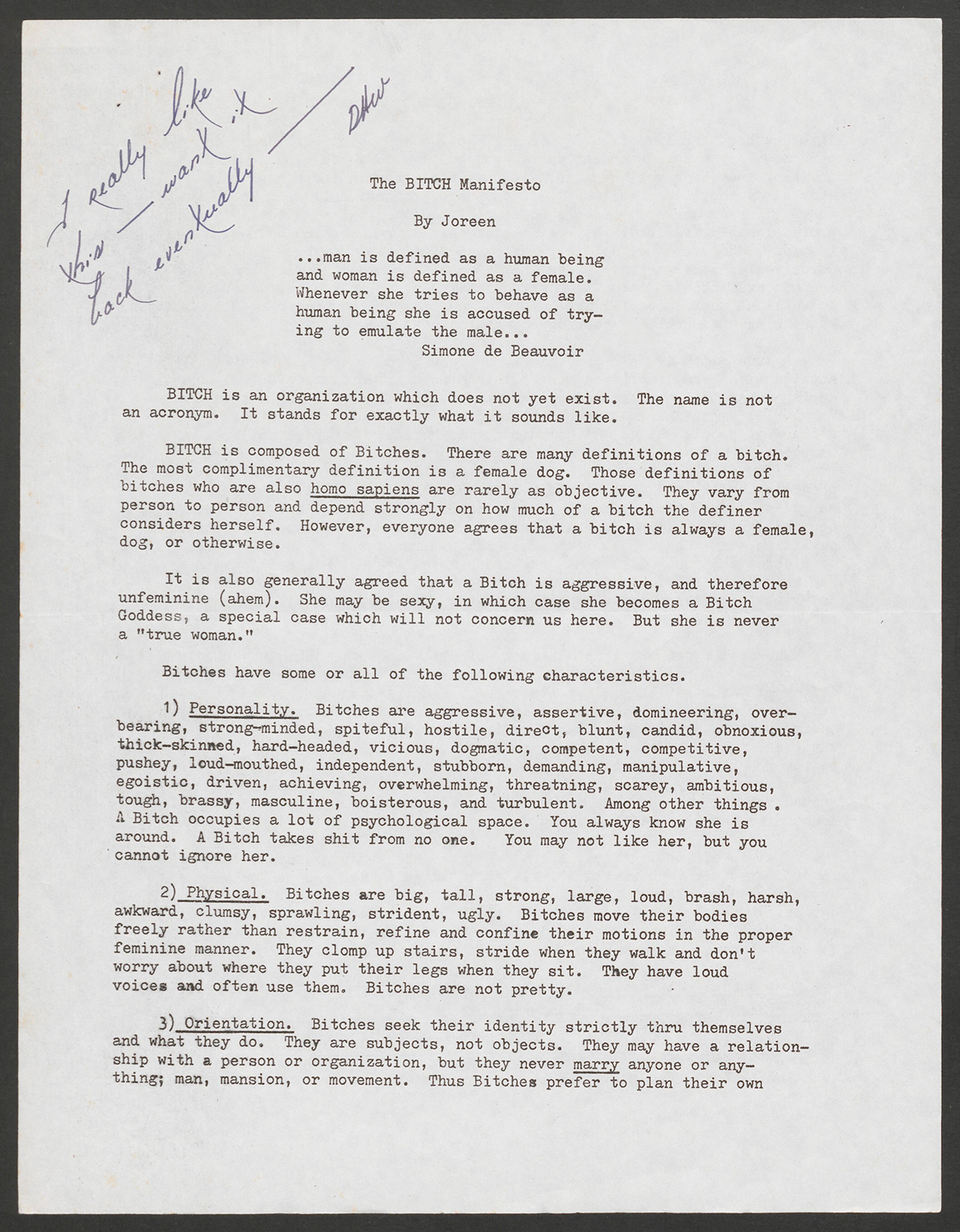
In her groundbreaking essay, Freeman reframed bitch as a figure of strength. By seizing control of the word and turning its meaning on its head, bitch received a feminist facelift, becoming a self-applied label for women who were ambitious, strong and independent, but unwilling to apologise for it.