No matter how one defines capitalism, the concept has served its critics well. Capitalism named an enemy, gave it a shape, and showed that it was on the march, threatening everything in its path. It still does. Scholars, by contrast, have often blanched at the term, dismissing it as political or polemical. While a subset of historians never gave it up, only recently has the historical profession come around to the position of the German scholar Jürgen Kocka: that as “a concept of historical synthesis,” capitalism is “unsurpassed.” Since the financial crisis of 2008, an entire subfield has been dedicated to “the new history of capitalism.” Its practitioners have rewritten the history of slavery, debt, accounting, real estate, prisons, finance, sex, insurance, and more.
Now these scholars face a challenge that the opponents of capitalism have long understood: Capitalism and its opponents depend on difference. Capitalism works at the margins, colonizing or cultivating systems and spheres that are not capitalist. Capitalism’s opponents also work at the margins. They work at the margins of time, reminding people of a time before capitalism and promising a time after it. They work at the margins of space, defending social spheres and geographic regions not yet overtaken by capitalism. Whenever capitalism triumphs, that fugitive space grows smaller, that alternative future grows dimmer. As that future disappears, it becomes harder to imagine or to posit a time, including a past, when capitalism did not exist. Everything—past, present, and future—becomes capitalism or is on its way to it.
The polemical elements of the word, the fact that partisans deployed it to mark the perimeter of what they were protecting from the forces they were opposing, once made capitalism a fruitful source of historical distinction and narrative. But when the polemic subsides and the perimeter disappears, when capitalism triumphs and is simply the way of the world, the job of the historian becomes infinitely more challenging and fraught with failure.
Enter Sven Beckert, the Laird Bell Professor of History at Harvard.
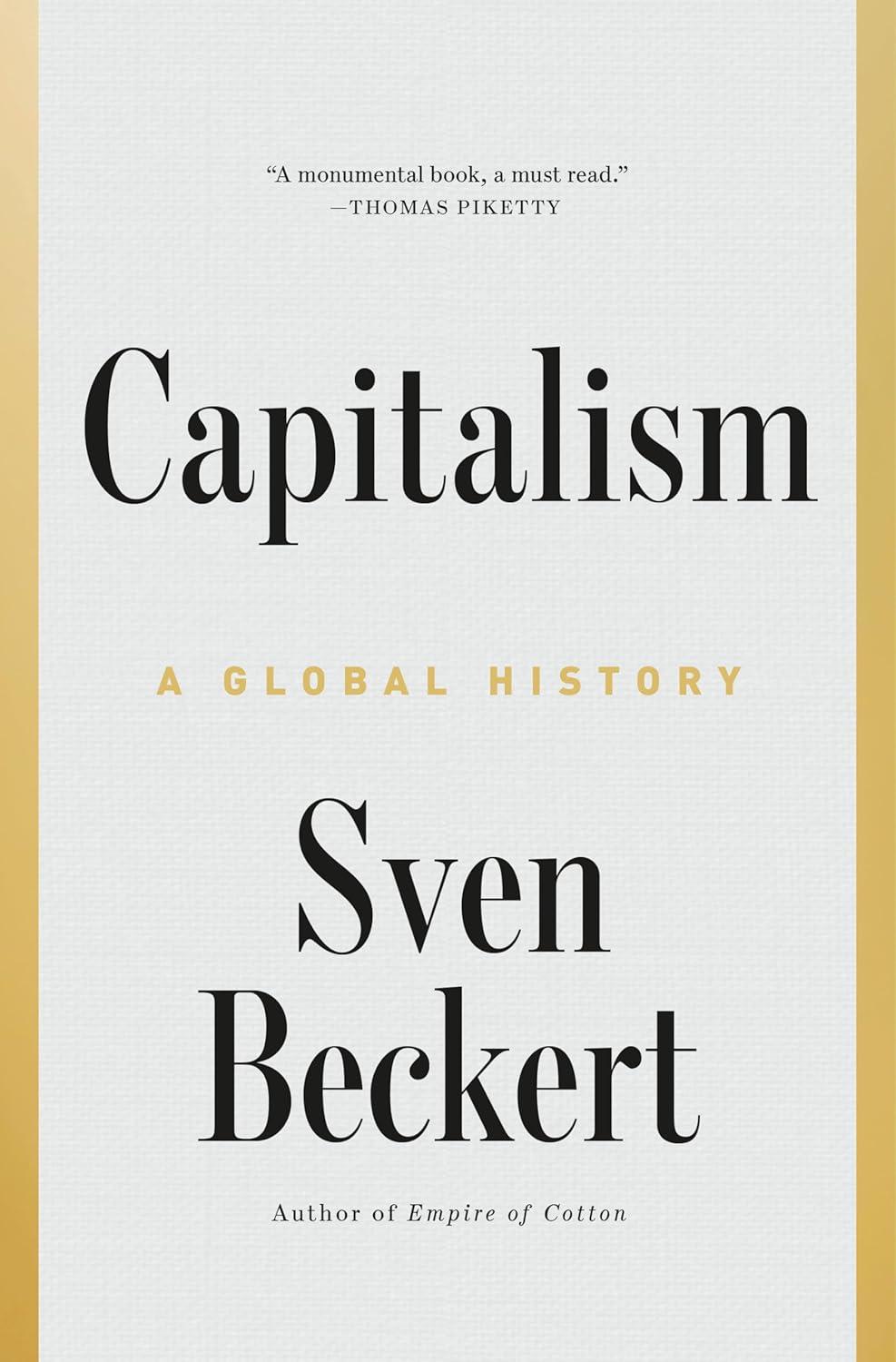
Beckert is a pioneer of the new history of capitalism, and like the ism he studies, his remit is always expanding. His first book was The Monied Metropolis, an illuminating if contained history of the making of the ruling class of 19th-century New York City. In Empire of Cotton, he told “the history of capitalism” through “the biography of one product.” Now, in Capitalism: A Global History, Beckert has freed himself from the shackles of the specific. Citing Nehru’s dictum that it is no longer possible to write history “in terms of any one nation or country or patch of territory,” that we must “think of the world as a whole,” Beckert claims that capitalism “can only be understood globally.” Capitalism, he maintains, did not become global; it “was born global.”