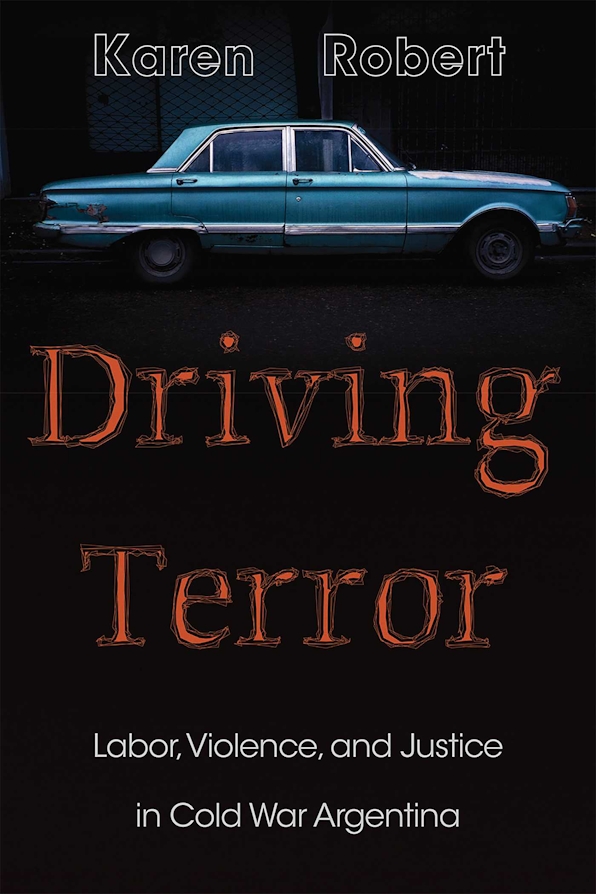
In Argentina, the Ford Falcon is associated in popular memory with two competing narratives—economic stability and the trauma of military dictatorship. Historian Karen Robert’s 2025 book Driving Terror: Labor, Violence, and Justice in Cold War Argentina puts these divergent memories at the center of her book, opening with a scene from the official retirement of the last Ford Falcon Taxi in 2004 in which a taxi driver, interviewed by the newspaper Clarín, states, “This is the last Falcon Taxi to be touched by the nostalgia of forty-three years of shared stories in Buenos Aires.” Robert contrasts this view by that of playwright and psychotherapist Eduardo Pavlovsky who countered, “Whenever a Falcon passed or slowed down, we knew there would be kidnappings, disappearances, torture, or murder.”
The same year as the Taxi’s retirement, human rights lawyers submitted a claim against Ford Motor Company in U.S. courts on behalf of 16 former autoworkers at Ford’s manufacturing plant in Argentina who, in 1976, were detained and tortured on Ford premises. The detention of Ford’s workers, notably those participating in union activities, was an example of direct collaboration between U.S. corporations and the military dictatorship. According to the case, documented in the book, “the company did so in order to suppress trade union activity at the Ford Plant.” Amnesty laws in Argentina made it difficult for human rights trials to take place in the country, hence the recourse to courts in the United States. However, the case was later moved to Argentina after the Amnesty laws were overturned in 2005.
The case, Robert notes, sheds light on aspects of the dictatorship that have been overlooked, including the experiences of workers and union activists as well as the collaboration of business leaders in the state’s violence. While Ford produced the Falcon in Argentina from 1963 until 1991, the book spans a slightly lengthier period from the 1960s until 2018. Robert provides a detailed look at Ford’s history in Argentina, including the role of industrial workers, who launched strikes to challenge the assumption that higher wages would lead to complacency; the use of Ford Falcons for kidnapping and disappearances; the Ford workers who were abducted in 1976; and the various attempts at seeking justice, including the court case against Ford Argentina. The focus on Argentina’s workers is particularly important given that, according to the 1984 Nunca Mas human rights report, 32 percent of Argentina’s detained and disappeared were workers.