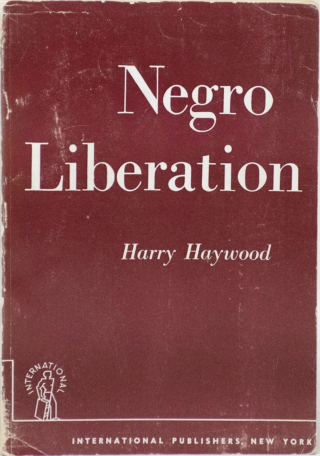
Originally published in 1948 and now newly republished, Negro Liberation surveyed the post–World War II landscape and found that little had changed since the war began. The Black Belt, which had served as a heartland for enslaved agricultural labor in the South, remained an internal colony of the United States. There, the racist treatment of Black Southerners buttressed the continued economic exploitation of workers, providing dramatic profits to a small number of planters and to Northern finance capital while immiserating everyone else. By making this argument, Haywood, a Communist Party member, was not only making the case for Black emancipation but also explaining how anti-Blackness contributed to the oppression of all laborers. The white supremacy legitimating the exploitation of Black people in the Black Belt was also the very mechanism that ensured the working class’s segregation in the North and prevented Black and white workers from uniting to win collective power.
Yet alongside this account was also a specific argument for Black liberation. Taking his cues in part from Lenin’s claim that colonized countries had a right to determine their own governance, Haywood argued that the Black workers of the Black Belt needed to exercise self-determination, as Lenin put it—that the Black people in the majority-Black regions of the South ought to have autonomous socialist governments. To prevent the rise of fascism, which Haywood argued was manifest in the Jim Crow South as well as in interwar Europe, Black agrarian and industrial workers had to unite and organize toward Black self-determination in the Black Belt. This would weaken US imperialism—for instance, by withdrawing the region’s production—and thereby aid other workers subjugated by the United States across the globe.
To fully understand Haywood’s position on the Black Belt and on workers more generally, it’s necessary to first understand his life. Born in 1898 to formerly enslaved parents, he grew up in a society that imparted a sense that Black people could never fully assimilate into America. The Omaha, Nebraska, of Haywood’s youth had not yet become the city in which Malcolm X’s pregnant mother endured an attack by the Ku Klux Klan. But his parents’ tales of slavery and his grandparents’ displaying their scars from the chattel regime soon educated him on American race relations. Reinforcing this lesson, his school taught that “Blacks were brought out of the savagery of the jungles of Africa,” Haywood recalled in his autobiography, Black Bolshevik, “and introduced to civilization through slavery under the benevolent auspices of the white man.”