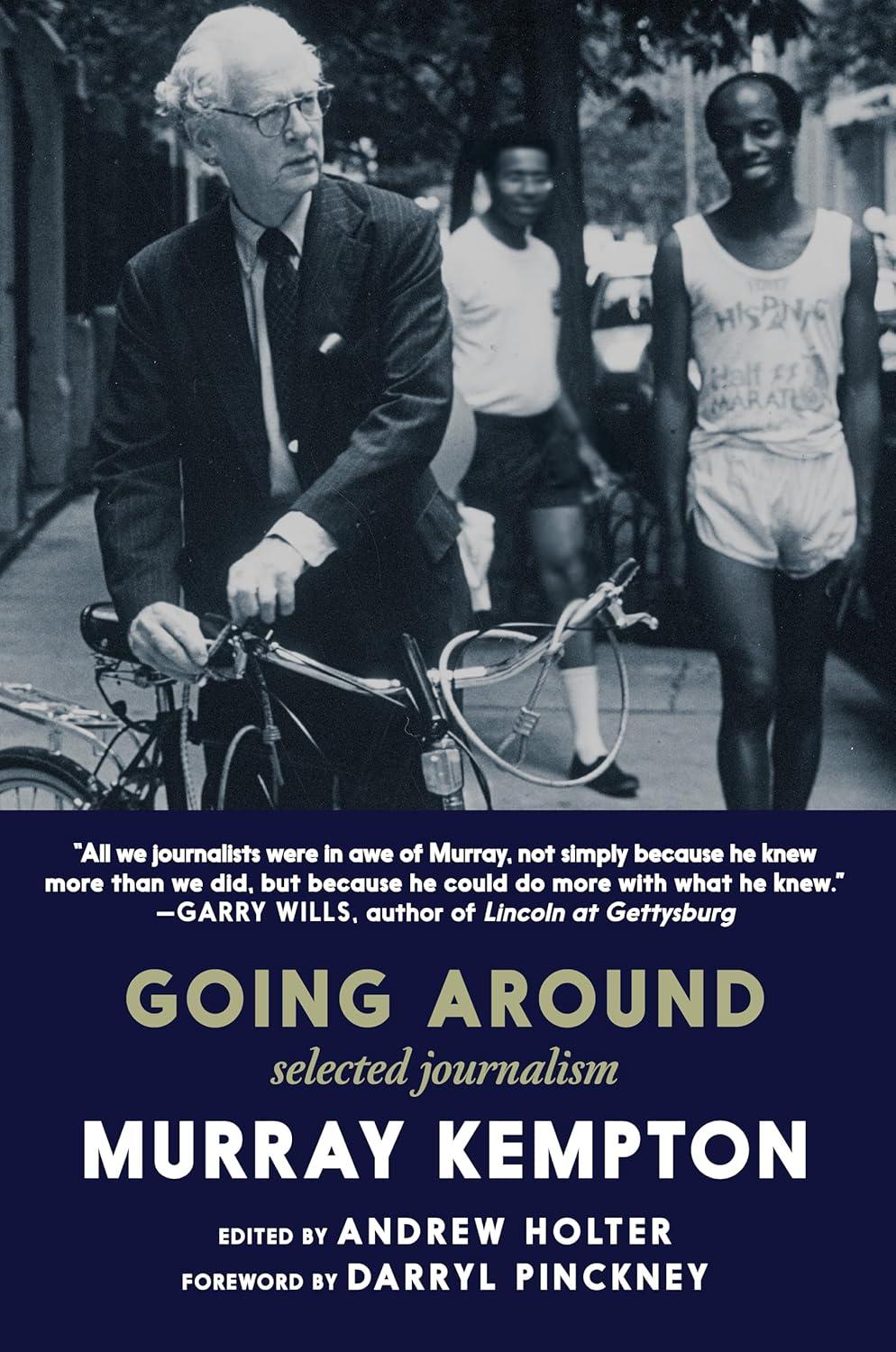
Readers of a new collection of legendary journalist Murray Kempton’s reporting, Going Around, may be tempted to think that if American news outlets had more reporters like Kempton, the public’s faith in the trade might be restored. That is an all too facile estimate of the current problems with journalism’s business model—from advertising revenue to subscriptions based on algorithms. But it is a reason to read this varied, enjoyable, and perceptive set of dispatches about American society from 1936 to 1997 by one of the nation’s gifted liberal journalists.
However, evaluations vary on the current state of the American press—too ideological or a business model that relies on polarization, part of what is missing is what Kempton always displayed attention to: fascinating details beneath, around, or hovering over a story. His coverage of the 1970 trial of the “Chicago Seven,” for instance, did not merely call balls and strikes in the conviction of Vietnam War protestors at the 1968 Democratic National Convention. (They received a sentence of five years, not for conspiracy but for bad manners during the trial.) Kempton applied the theme of decorum to the president, Richard Nixon, the rising distrust among Americans of their government, and the conduct of police in the face of public protest. Instead of wagging a finger at either side of the debate on Vietnam or at the president, Kempton worried about the health of American society. He saw America’s problems in their complexity. But he did so, not to show off but because he identified with the country and wanted America to do better.
Andrew Holter, co-editor of the volume, supplies an important biographical introduction to Kempton, who in the history of American journalism functions as a bridge between H. L. Mencken and the “gonzo” reporting of Hunter S. Thompson and Tom Wolfe. Born in Philadelphia in 1917, at the age of four, Kempton moved with his mother—his father had recently died in the Spanish flu pandemic—to her hometown of Baltimore. This relocation put Kempton in the city where Mencken was establishing his reputation as a provocateur extraordinaire. Kempton did eventually overlap with Mencken when he started as a journalist, but before that could happen, his mother and his brother lived among Baltimore’s “down-at-the-heels” aristocracy, which included the likes of Alger Hiss, and the infamous “Mrs. Wallis,” the Duchess of Windsor, married to Prince Edward, Duke of Windsor.