At war’s end, four million people who had been enslaved were now free and had to be incorporated into American society in a different role. How would this be accomplished? On what terms would this integration be carried out? What about the fate of White southerners, those who had enslaved people and others whose lives were indelibly influenced by the “peculiar institution” of slavery? Slavery had been a useful mechanism for holding White supremacy in place. With slavery gone, the majority society could choose to rewrite the story of race in the country and move forward, or it could attempt to reconstitute the old world, denying Black people full citizenship.
Some members of Congress, the so-called Radical Republicans and even the more moderate Republicans, understood that social life in the United States should be based upon the changes—and, one should say, the opportunities—wrought by war and the destruction of the slave system. The law would be the mechanism for the transformation, bringing Black people into full citizenship.
Yet as forceful as congressional leaders can be, only the president of the United States has the advantage of what Theodore Roosevelt called “the Bully Pulpit” of the office to help shape public opinion. The country needed a strong leader, a person able to see beyond the racial mores and the expectations that had been set in the pre-war years. History shows that having the right person in place at the right time matters greatly.
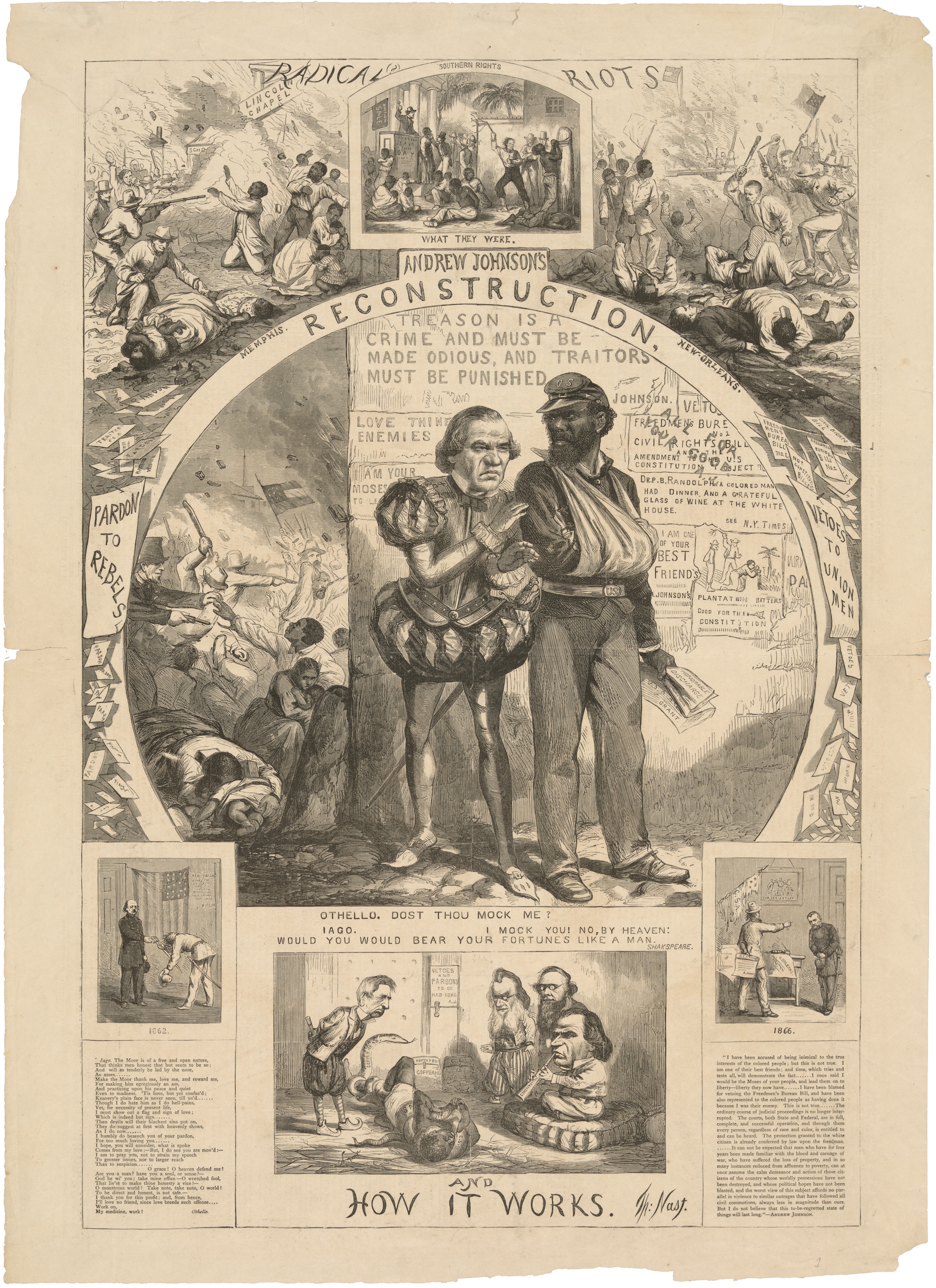
Johnson was the wrong person at a critical time. He had no interest in using his position to equalize citizenship in the United States. He was an inveterate racist who did not accept the idea that American society had to be restructured to accommodate African-Americans on an equal basis. Even in his own time, when racism was endemic, observers noted that Johnson had “an almost unconquerable prejudice against the African race.” He had reluctantly agreed that slavery should end, but he thought emancipation should be the extent of the change in status for Black Americans. They would exist in society like landless peasants, dependent upon Whites for sustenance and subject to their whims and violence. Legalized slavery would be gone, but the ethos of White supremacy would remain almost as powerful as it was when Black people were designated as property.
Think of what it meant to have a man who despised Black people as the President during the era when the fate of Blacks in the United States after slavery was being decided. No sympathy or empathy. No human charity. Only implacable hostility.