Central America occupies a special place in the history of the North American Congress on Latin America (NACLA). During the 1980s, NACLA activists traveled to the isthmus and played an important role in bringing attention to its revolutionary and counterrevolutionary upheavals. The NACLA Report, for its part, covered developments in Nicaragua, Guatemala, and El Salvador with remarkable depth—not only because of United States intervention and complicity in the violence, but also because revolutionary movements in those countries inspired tremendous optimism among U.S.-based scholars of Latin America. The complicated origins and legacies of that climactic period in Central American history continue to motivate significant research interest.
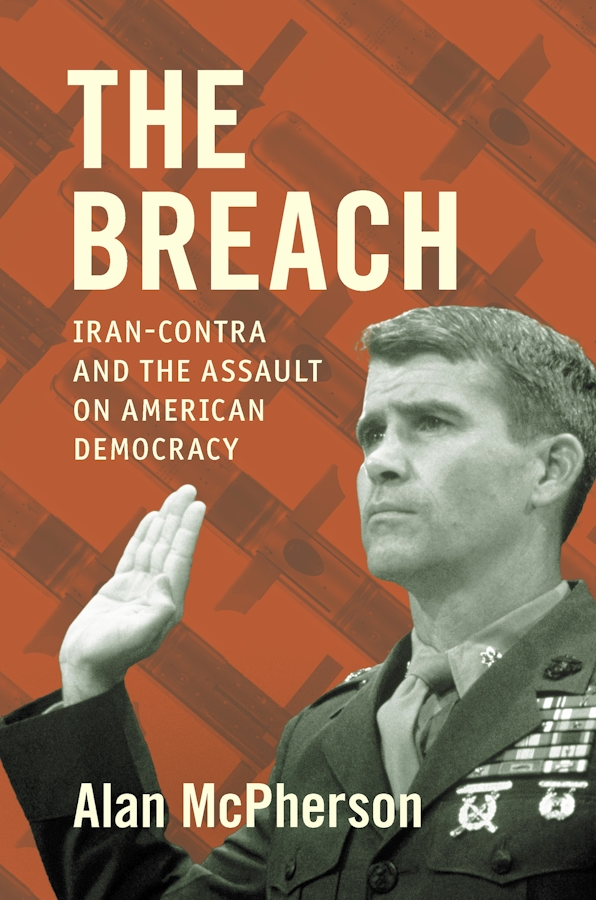
For most Americans, though, the Cold War in Central America was a historical footnote consisting of two hyphenated words: Iran-Contra. The image conjured is not one of left-wing guerillas, right-wing death squads, or tropical mountain jungles, but rather of Lieutenant Colonel Oliver North, whose medal-laden uniformed figure adorns the cover of Alan McPherson’s The Breach: Iran-Contra and the Assault on American Democracy. The actual events in Nicaragua—or Iran, for that matter—and their international implications left a far fainter impression on the American psyche than the domestic political scandal that rocked Washington in the latter half of the 1980s.
Unfortunately, even that memory is fading. When President Donald Trump was impeached in 2019 for abuse of power and obstruction of Congress—stemming from allegations that he pressured Ukraine to investigate Joe Biden, the likely Democratic nominee in the following year’s election—Iran-Contra appeared less frequently in public discourse than one might have expected. Watergate, despite occurring a decade earlier and involving crimes arguably less serious than those of Iran-Contra, is a more prominent historical reference for presidential abuse of power in our time.
One reason is the sheer complexity of the Iran-Contra operation and its cover-up. While Watergate could reasonably be summarized as a break-in, the American public—in the words of a journalist McPherson cites—saw Iran-Contra “as the policy equivalent of quantum physics,” too complicated to capture interest beyond specialists.
McPherson’s book thankfully proves otherwise. It is the clearest, most accessible account of the scandal ever written. Leveraging a profound knowledge of existing scholarship as well as a forensic review of the most recently available documentary evidence, he makes a strong case that Iran-Contra matters now more than ever.