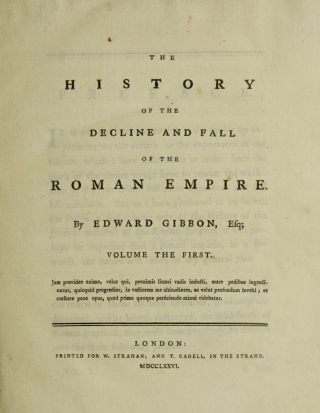
According to Gibbon himself, the inspiration for his great work came during a Grand Tour of the continent, when he observed a group of cowled mendicant friars dancing barefoot as they sang vespers in the ruins of Rome’s Temple of Jupiter. For him, it was a startling vision of the cycles and entropies that mark the human story. Inspired by his classical predecessors, Tacitus and Cassius Dio, Livy and Suetonius, Gibbon endeavored to answer the question of why a once-great empire ruled from its most glorious city would descend into a backwater in but a few generations. It was a salient question for those in the eighteenth century involved in affairs of state—including the author himself, who had sat for a time in Parliament. The composition of The History of the Decline and Fall of the Roman Empire, each volume of which Gibbon described as requiring something like the labor of childbirth, was bracketed by revolutions. The first volume, which covers the period from the first-century Nerva-Antonine Dynasty until the fourth-century Council of Nicaea, was published four months before the Continental Congress would sign the Declaration of Independence, going through six editions over the next decade. The sixth and final volume, which ends with the fall of Constantinople in the fifteenth century, was printed less than a year before an enraged phalanx of sans culottes stormed the Bastille. George III, the monarch who was about to lose his own empire, archly observed of that volume and its author, “Another damned fat book.… Scribble, scribble, scribble, eh Mr. Gibbon?” He might instead have taken it as a helpful primer on how human passions drive people to resent the elites that oppress them, whether during Rome’s Servile Wars or Britain’s American uprising.
While revolutionaries on either side of the Atlantic dreamed of the rise of empires (or rather republics), Gibbon focused on their decline, warning about the hubris of states and civilizations, no matter how seemingly eternal. Perhaps with both meanings of the word in mind, Gibbon wrote that the “revolution of ages may bring round the same calamities; but ages may revolve without producing a Tacitus to describe them.”
Having no Tacitus, we are fortunate to have had a Gibbon, whose work may prove less forensic than prescient. “There exists in human nature a strong propensity to depreciate the advantages, and to magnify the evils, of the present times,” writes Gibbon, and so it may be. Contemporary critics of this moment may devalue the glories of penicillin and flush toilets, but only a cynic, liar, or fool would trade this present for Gibbon’s, even if the eighteenth century had soaring hopes for the future that we can only wistfully share. It is almost impossible to read Decline and Fall without seeing America as Rome.