At the start of the Civil War, enslavers in the nation’s capital were compensated for the loss of their human property. The payment scheme hoped to ensure enslavers’ loyalty and garner their support for ending slavery. Three decades later, after 11 Italians were lynched in 1892 New Orleans, strained diplomatic relations and the Italian government’s threatened military action convinced President Benjamin Harrison to compensate the murdered men’s families. Native Nations whose property was confiscated during America’s genocidal expansion fought for compensation for almost two centuries. Claims based on the U.S. Government’s repeated treaty violations were filed, “as early as 1831.” Yet congressional chicanery, foot-dragging, and bureaucratic inertia kept these claims sloshing through the Indian Claims Commission and the U.S. Court of Federal Claims for the length of several lifetimes. Settlements and payouts slowly dripped out, with the final claim paid in 2006. For their staggering continent-spanning losses, the US Court of Federal Claims ordered the Native Nations to be paid what amounted to about $1.3 billion in total. Despite no evidence of disloyalty, WWII-era Japanese Americans were stripped of their land, rounded up, and sent to domestic concentration camps during the war. After another decades-long struggle, 60,000 Japanese victims of American fascism received token remuneration ($20,000 per person) for the persecution their government inflicted.
In other words, the United States government has repeatedly endorsed the idea of paying reparations to wronged parties (and even enslavers). Black Americans, who have been enslaved, lynched, had their land stolen, been locked out of jobs and homeownership, and faced disproportionate and unjust incarceration are owed a similar debt. But reparations are an American tradition that, like many American traditions, has excluded Black people.
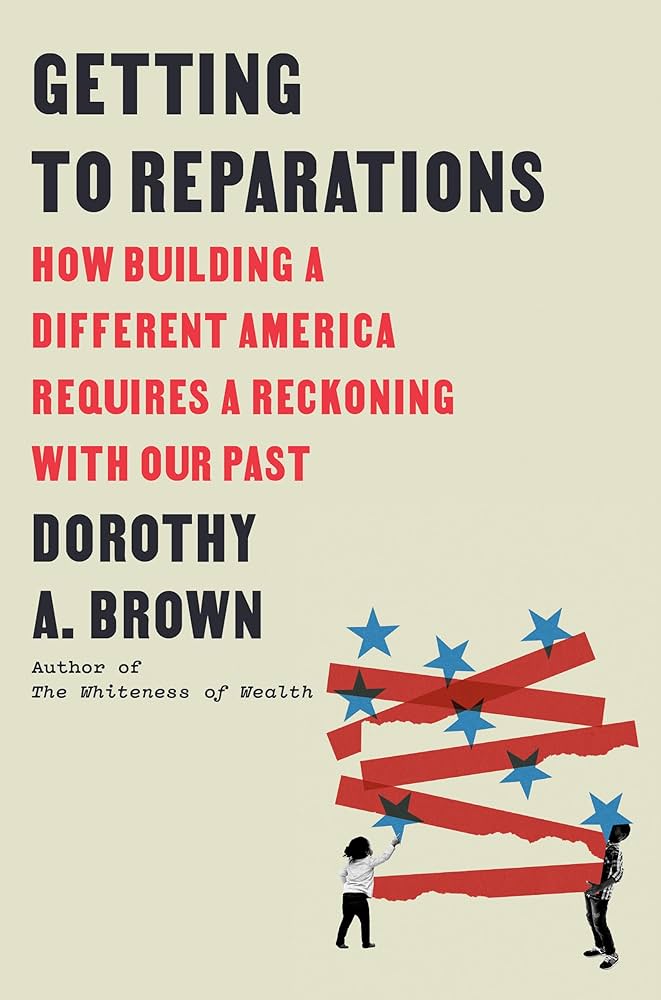
Dorothy Brown’s Getting to Reparations: How Building a Different America Requires A Reckoning with Our Past is a narrative of the possible that hopes to get the federal government’s debt to Black Americans paid. The Martin D. Ginsburg Chair in Taxation and a Professor of Law at Georgetown University, Brown is widely known for her pathbreaking work on race and the tax code. Her new book is a history of reparations, a case for the necessity of compensation that goes well beyond slavery, and a policy platform for getting reparations paid. True to her legal training, Brown’s argument rests on precedent. Reparations have happened before. She aims to make them happen again. Brown’s ethical case for reparations convinces, as any fair reckoning would acknowledge the horrors visited upon Black Americans cry out for restitution. The political barriers to reparations are, as Brown acknowledges, more difficult, as the social and legal regimes designed to strip value from Black life must be convinced to pay their debts.